
Unlock Brazil’s Rhythm: Navigate Vibrant Linguistic and Cultural Diversity of Brazil.
Brazil is not one of the countries that can be put in a box. It becomes obvious that Brazilian cultural diversity is not just a theory as soon as one takes a glance at the surface and realizes that it is a very real phenomenon, which has been forming over centuries, migration waves, and cultural interaction. The diversity of languages, customs, and worldviews reigns in Brazil, starting with megacities to small rainforest villages, and it is evident to affect day-to-day life, working relationships, and communication patterns in endless ways.
Linguistic Landscape: A Brazilian Take on Languages
Although Portuguese is the official and dominating language by an overwhelming majority in the life of the populace, in education, and the media, the linguistic fabric in Brazil is astonishingly intricate. It would be important to understand this landscape in order to fully appreciate the nature of this country.
Native and Foreign Languages
Along with Portuguese, there exist over 200 Indigenous languages spoken by approximately 300 different people in Brazil. There are languages with tens of thousands of speakers, like the Tikuna, Kaingang, or Guarani, that are vital in preserving the culture. Moreover, the immigrant communities preserve their native languages in isolated parts of the nation. Such dialects are Italian and German in the South, Japanese in the city of São Paulo, and Levantine Arabic in cities. These languages flourish in communities, churches, and even cultural associations to further provide local identity.
Portuguese: The National Unifier with Regional Nuances
Portuguese in Brazil is not homogeneous. It is the economic and social lingua franca that is necessary to national integration and international interaction. However, it splits into regional dialects, different words, and even grammatical nuances. The slang and accent of a Carioca, Rio de Janeiro, is immediately understood by a Gaúcho, Rio Grande do Sul, but they all perform business and official communication using a standard form of Brazilian Portuguese that they mutually understand. This territorial difference in the same official language highlights the high level of Cultural Diversity of Brazil.
The Cultural Diversity of Brazil: A Living Mosaic
The Brazilian Cultural Diversity has a complicated background. The first to take care of the land were the indigenous people, and then the Portuguese colonists, the forced migration of many Africans, and the subsequent coming of European, Emergent Middle Eastern, and Asian immigrants. All the groups left a permanent trace in Brazilian life, which can be seen through food, music, religion, and social way of life.
Imagine Brazil as one long conversation where new voices continue to join in. No single voice ever dominates totally, yet together they create a rhythm that ultimately turns out to be uniquely Brazilian.
Regional Expressions of Culture
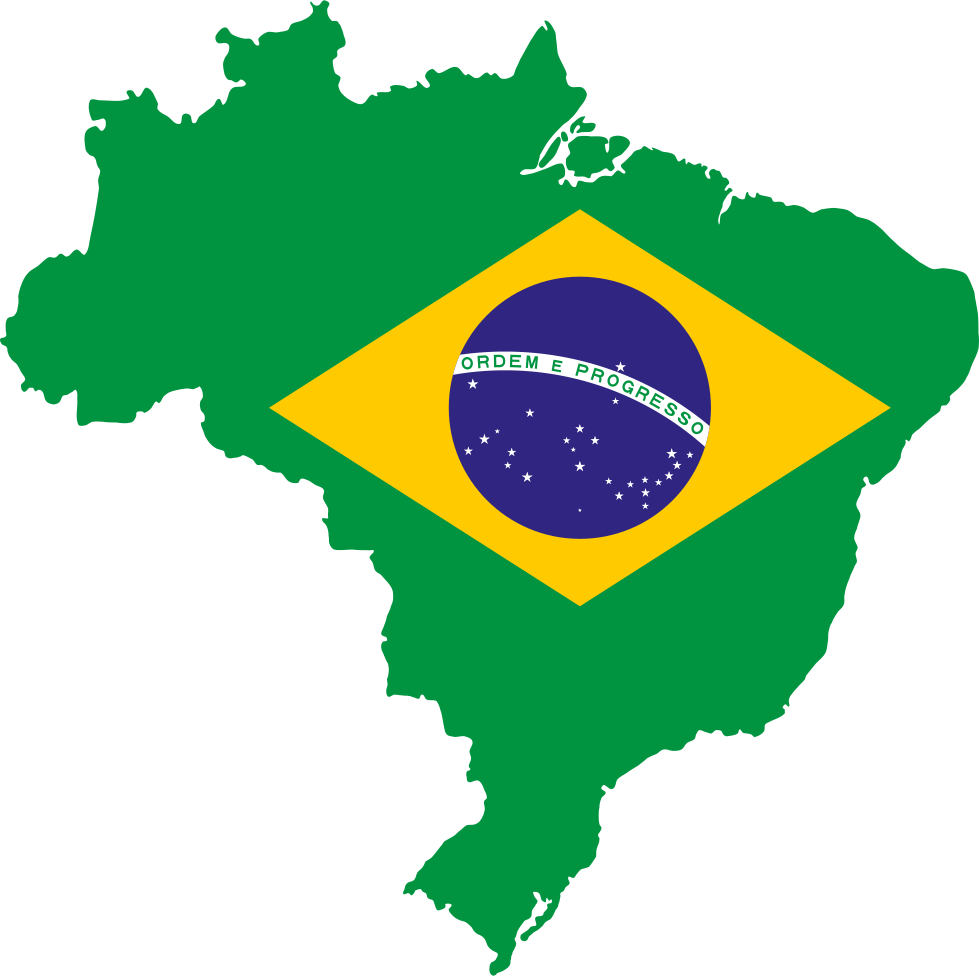
Brazil is usually regarded as one country, but in cultural terms, it feels like many.
North and Amazon Region
It’s here that Indigenous heritage expresses itself most predominantly. Cultural practices relate more keenly to nature, and traditional knowledge assumes a central place within the community life of the people.
South and Southeast
These are areas of great European and Asian influx. In places like São Paulo, one will find a very cosmopolitan speaking multitude of languages in a fast-paced city that is at the same time particularly warmly Brazilian.
Linguistic and Cultural Diversity of Brazil Beyond Portuguese
Though Portuguese was adopted as the official language, real linguistic practice in Brazil is much more diverse. More than 200 Indigenous languages survive side by side with immigrant German, Italian, Japanese, and Arabic, among many others. Even within Portuguese itself, accents and expressions differ greatly.
I have been in a cross-regional meeting where all people were technically speaking the same language, yet misunderstandings added up fast. It was not vocabulary; it was context. That proved to me how easily meaning can slide when cultural nuance is not paid attention to.
Communication Challenges in a Diverse Brazil
In international business, academic collaboration, or global events, diversity presents real communication challenges. In Brazil, the tone, indirectness, and relationship-focused dialogue play a major role in how messages are received.
This is where professional language support steps in. Organizations such as TransLinguist help bridge these gaps via simultaneous interpretation for live events so that all participants of different linguistic and cultural backgrounds can be fully engaged. For distributed teams, on-demand remote interpretation for Zoom or Microsoft Teams ensures that conversations flow naturally without disrupting the momentum. In technical or specialized fields, multilingual glossary development ensures consistency while respecting local language nuances.
Why Respecting Brazil’s Diversity Matters
To oversimplify Brazil is to do violence to its people. The Cultural Diversity of Brazil demands curiosity, patience, and adaptability. When individuals and organizations invest in understanding cultural layers, clearer communication is achieved, better relationships are built, and collaboration becomes more human.
Take the Next Step
Getting at the Cultural Diversity of Brazil does not mean getting everything right – what matters is intention. If you are ready to speak with clarity and cultural confidence, working with TransLinguist will have you turning diversity from a challenge into a strategic advantage.
FAQs
Are Indigenous languages still relevant today?
Yes. Many are in active use, and their speaking bears monumental importance toward cultural preservation.
Why is cultural awareness important in Brazil?
Because this is a country where trust and relationships lead to communicating and making decisions.
Do businesses really need interpretation services in Brazil?
Mostly yes, when it is multinational or cross-regional.